


_page-0001.jpg)

 (1).jpg)

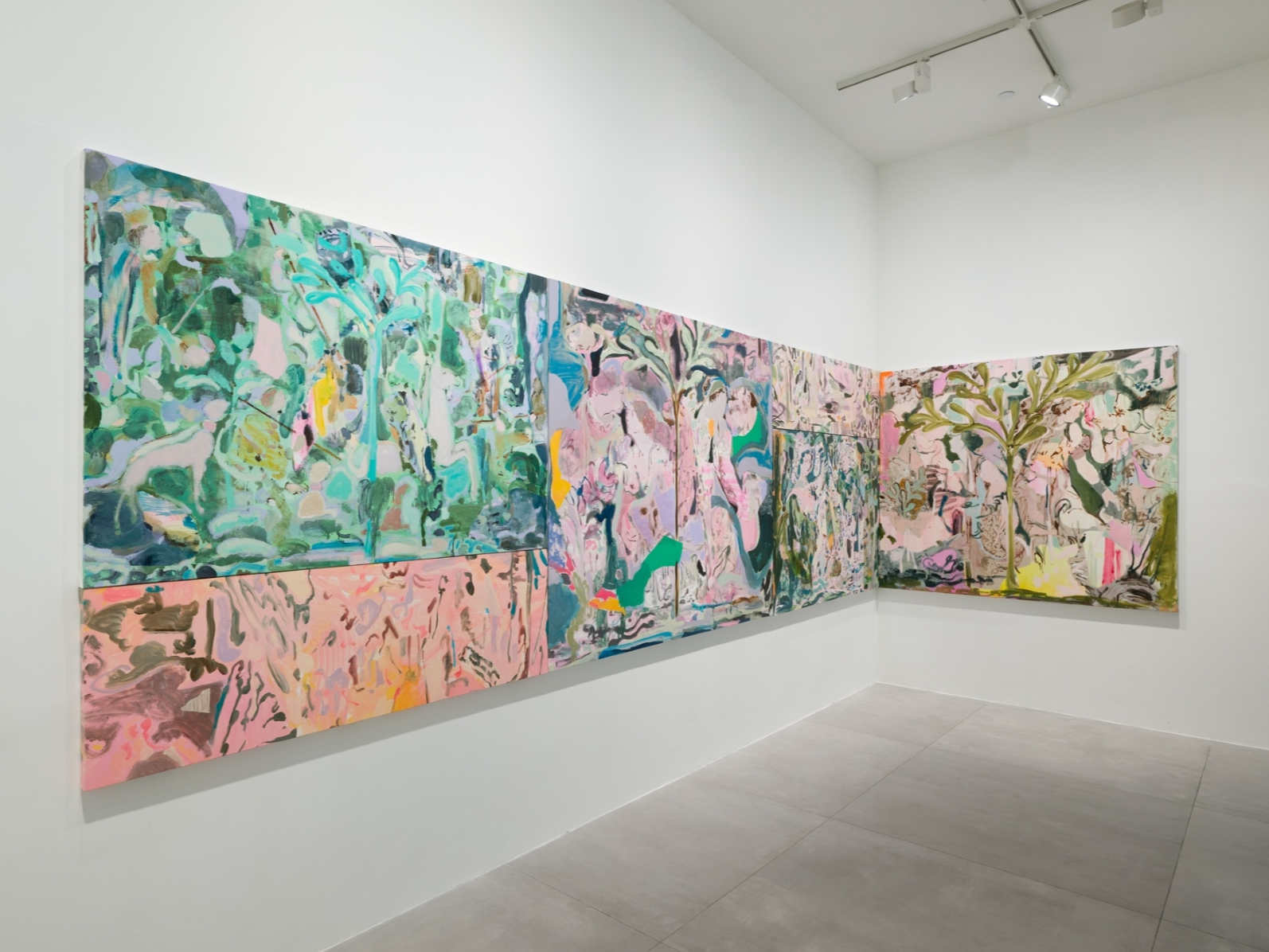
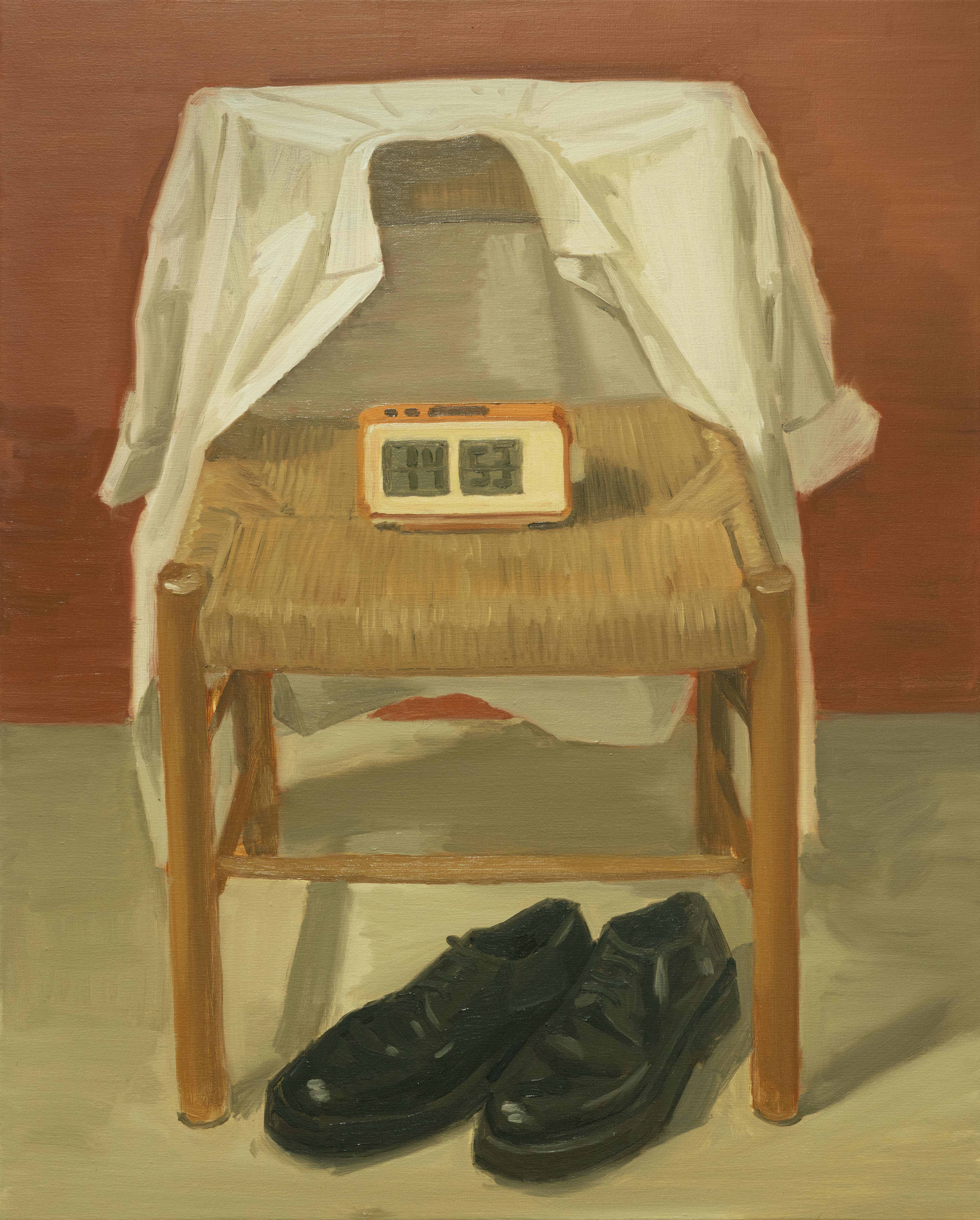
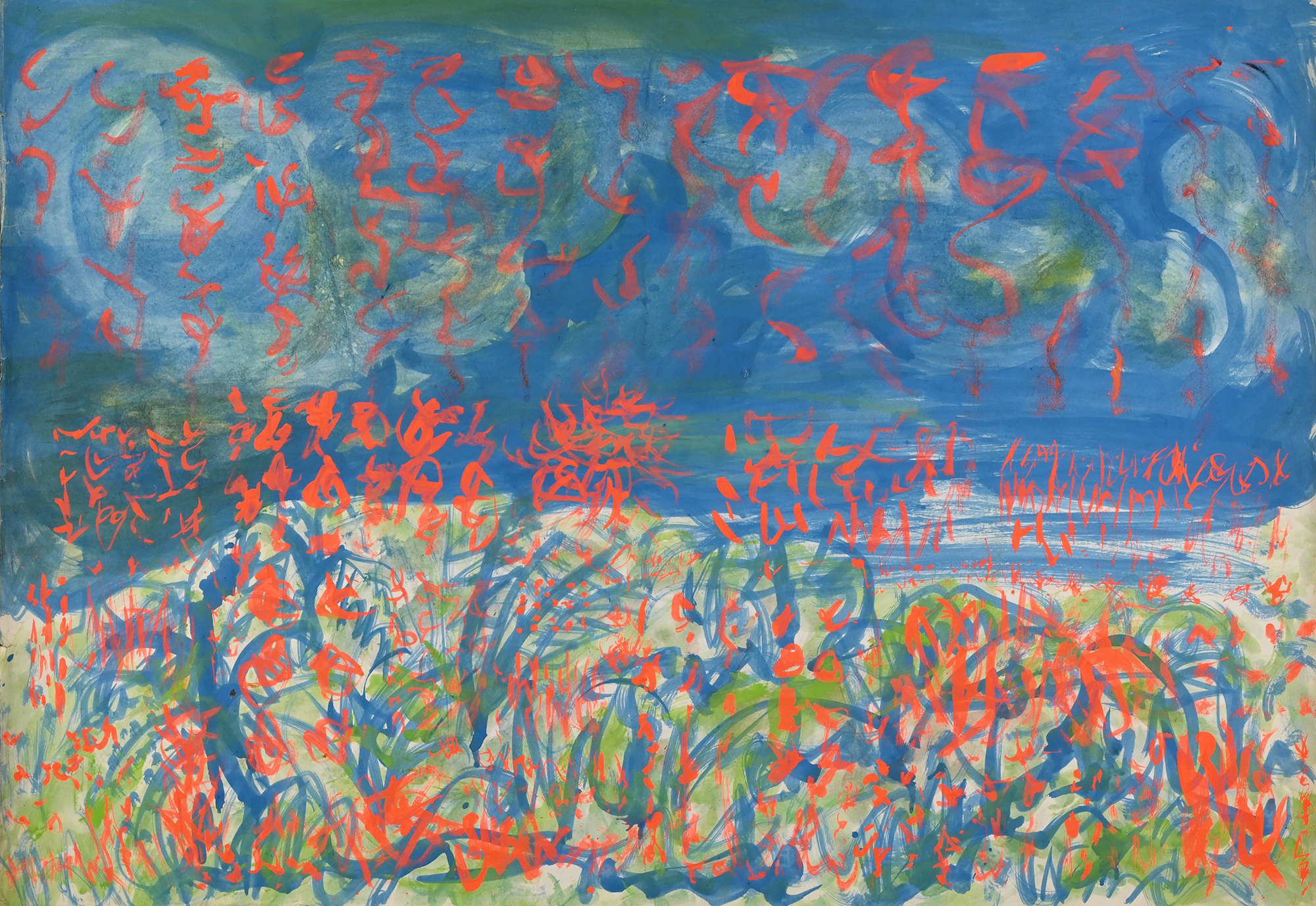



In Tomo Campbell’s paintings, motifs repeat and become lost in a sea of surrounding abstract marks. Hierarchies between layers are flattened. The viewer is sent on an endless search for meaning and connection. The British artist has long been inspired by tapestries, and in recent years, the display of his paintings has taken on the immersive nature of this sprawling, traditional art form. In ‘Search Party’ at Double Q, Campbell anchors the space around a single, continuous L-shaped centrepiece that invites the viewer to journey into the work. Here, a long line of canvases surrounds the viewer with trees, unicorns, and sculptural figures.
This form of display also evokes the traditional frieze format, which is rooted in classical architecture and presents a continuous narrative. Over the centuries, the frieze has evolved to a looser compositional form, which bends our understanding of how space and time exists within the canvas by turning the wall into an unbroken visual field. As such, we become consumed by Campbell’s work, becoming another person on the hunt rather than simply an observer. The continuity of the paintings in the installation invites the viewer to explore threads between each canvas, no longer individual pieces but one connected whole.
Campbell’s fascination with textile mediums such as tapestry and patchwork imbues his paintings with a unique quality. His inspirations are craft-based, methodical, and often communal in their creation. In Campbell’s paintings, abstract marks are given the same weight as his figures, while he leaves room for the viewer to project their own knowledge and experience onto the imagery that surrounds them. He is particularly drawn to late medieval references. ‘The Devonshire Hunting Tapestries’ at Victoria and Albert Museum and ‘The Unicorn Tapestries’ at The Met Cloisters are ongoing influences, both made in the 15th century. Like Campbell’s paintings, this period of tapestries eschews realistic perspective, combining recognisable forms and looser visual elements.
Campbell is also inspired by Peter Paul Rubens’ early 1600s sketches made for tapestries; these drawings are less refined than the Flemish artist’s meticulous paintings, which allowed the weavers to input their own flair. Campbell’s paintings take a similarly informal approach to their mark making and subject matter, suggesting the possibility of further artistic development rather than a neat end point. The blurred depth of Japanese woodcuts can also be observed in the artist’s installation, where the eye is encouraged to move over the work rather than easily consuming it with one look. He also borrows the repeating, covering and revealing aspects of patchwork. He finds parallels between the repeated act of stitching and passing down quilts through numerous hands and generations with his own style of painting, as he takes emblems and icons from art history and adds something new each time.
This hunt to understand the visual scene is mirrored in the literal hunts suggested in his works. ‘Search Party’ becomes a feedback loop with no grand end, as the eye travels over images of boats in the forest and figures on horseback. The unicorn is a symbol of something that might or might not be there, a stand-in for meaning. As the figures search for the unicorn, the viewer may also search to get something out of the painting. Subjects, viewers and artist are caught in an eternal quest, looking for something that can never quite be found. The whole point is to keep looking. The artist himself never knows how a painting might conclude, as he tapes areas and then reveals them, he finds accidental contrasts and repetition.
Campbell is interested in showing all the possibilities that can come from a limited number of starting points, with different versions of the work powering one another. Shown together, their minute differences can be observed and delved into. He hopes to encourage the viewer to keep looking, frustrating their need to settle on one easy understanding. Ultimately, his work captures the frustration but also joy of the hunt, when finally finding what you are looking for can be a let-down. Instead, his works revel in a constant state of searching, mirroring the pleasure that can be found in keeping the hunt going throughout life.
Written by Emily Steer
.png)